The composers
The Ionian school: Mantzaros, Xyndas and Samaras
Three Corfu-born composers who turned Italian opera training into a Greek national music, and the tunes of theirs you already know.
Reserve your table ↗Quick answer
The Ionian or Heptanese school was a group of composers from the Ionian Islands, active from the early nineteenth century to about the 1950s. Corfu produced three of its best-known figures: Nikolaos Mantzaros, who set the Greek national anthem, Spyridon Xyndas, who wrote an opera with a Greek libretto, and Spyridon Samaras, who composed the Olympic hymn.
Three composers from Corfu
| Composer | Dates | Known for, per Wikipedia |
|---|---|---|
| Nikolaos Mantzaros | 1795–1872 | The musical setting of the Hymn to Liberty, adopted as the national anthem in 1865 |
| Spyridon Xyndas | 1812–1896 | O ypopsifios (1867), described as the first full-scale opera on a Greek libretto |
| Spyridon Samaras | 1861–1917 | The Olympic Hymn, first performed in 1896 |
A school defined by place
Wikipedia’s article on the Ionian school describes it as the work of a group of composers from the Heptanese, the Seven Islands. Its heyday ran from the early nineteenth century to about the 1950s, and it is conventionally split into a first generation, from 1815 to the end of the 1860s, and a second generation from 1871 onward. The most prominent names it gives are Nikolaos Mantzaros, Spyridon Xyndas, Spyridon Samaras and Pavlos Carrer. The islands were a different cultural world from the Greek mainland, which had spent centuries under Ottoman rule. Wikipedia’s article on the Old Town of Corfu says Venice ruled Corfu from 1386 to 1797, and Venetian training in Italian music was a natural part of that inheritance. That context is why a composer from Corfu in 1830 was far more likely to study in Naples or Milan than in Athens.
From Italian opera to Greek words
According to the same article, early works of the school were shaped largely by Italian tradition. By the 1820s the composers were developing what the article calls a national music, using the Greek vernacular language and, later, folklore from the Ionian Islands and mainland Greece. In Mantzaros’s case, Wikipedia says he composed the first concert aria in Greek, the Aria Greca, in 1827, and that from 1819 he regularly visited Venice, Bologna, Milan and Naples. That is a useful way to listen to anything from the school. Expect Italian-style melody and structure, with Greek texts and, later, Greek tunes. The same pattern, a European form filled with a local content, is one reason these composers are still taught as a school and not as isolated individuals.
Mantzaros and the anthem
Nikolaos Mantzaros was born in Corfu on 26 October 1795 and died there on 12 April 1872. Wikipedia says he never considered himself a professional composer and taught the island’s young people without profit, and that he presented his first compositions in 1815 at the San Giacomo theatre in Corfu. From 1841 until his death he was artistic director of the Philharmonic Society. The setting of Solomos’s poem is the work that carried his name beyond the island. The article says the first and second stanzas were adopted in 1864 as the Royal Anthem and on 28 June 1865 as the national anthem. It also flags that the 1828 date for the composition rests on a self-published source, a caution worth repeating whenever the date appears in a travel brochure.
Xyndas and the Greek-language opera
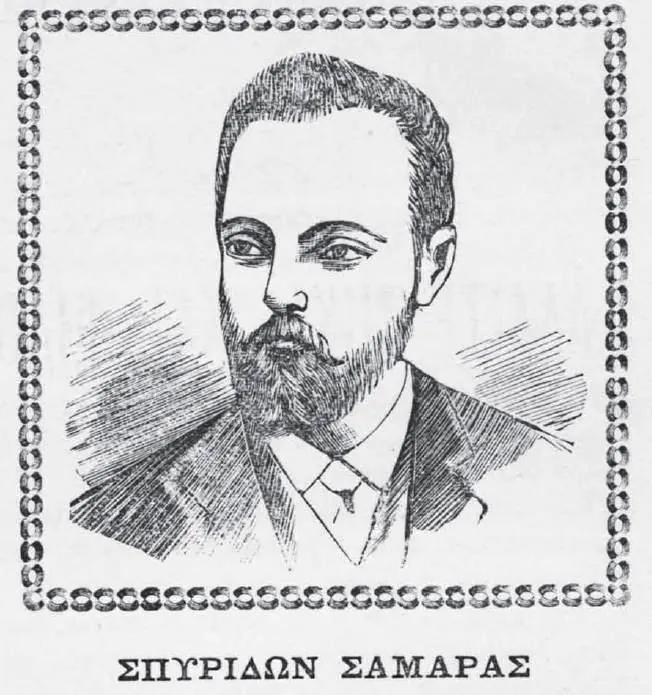
Spyridon Xyndas was born in Corfu on 8 June 1812 and died in Athens on 25 November 1896. He studied theory with Mantzaros from 1823, continued in Naples and Milan, and in 1840 helped found the Philharmonic Society, where he taught for several years. His opera O ypopsifios, The Parliamentary Candidate, first given in 1867, is described by Wikipedia as the first full-scale opera based on a libretto in Greek, and it is the only one of his operas that survives. Wikipedia adds that many of his works are believed to have been destroyed in the 1943 bombing of the Municipal Theatre of Corfu by the Luftwaffe. That loss is a reminder of why the island’s musical history is less visible than its architecture: the walls survived the sieges, but much of the paper did not.
Samaras and the Games
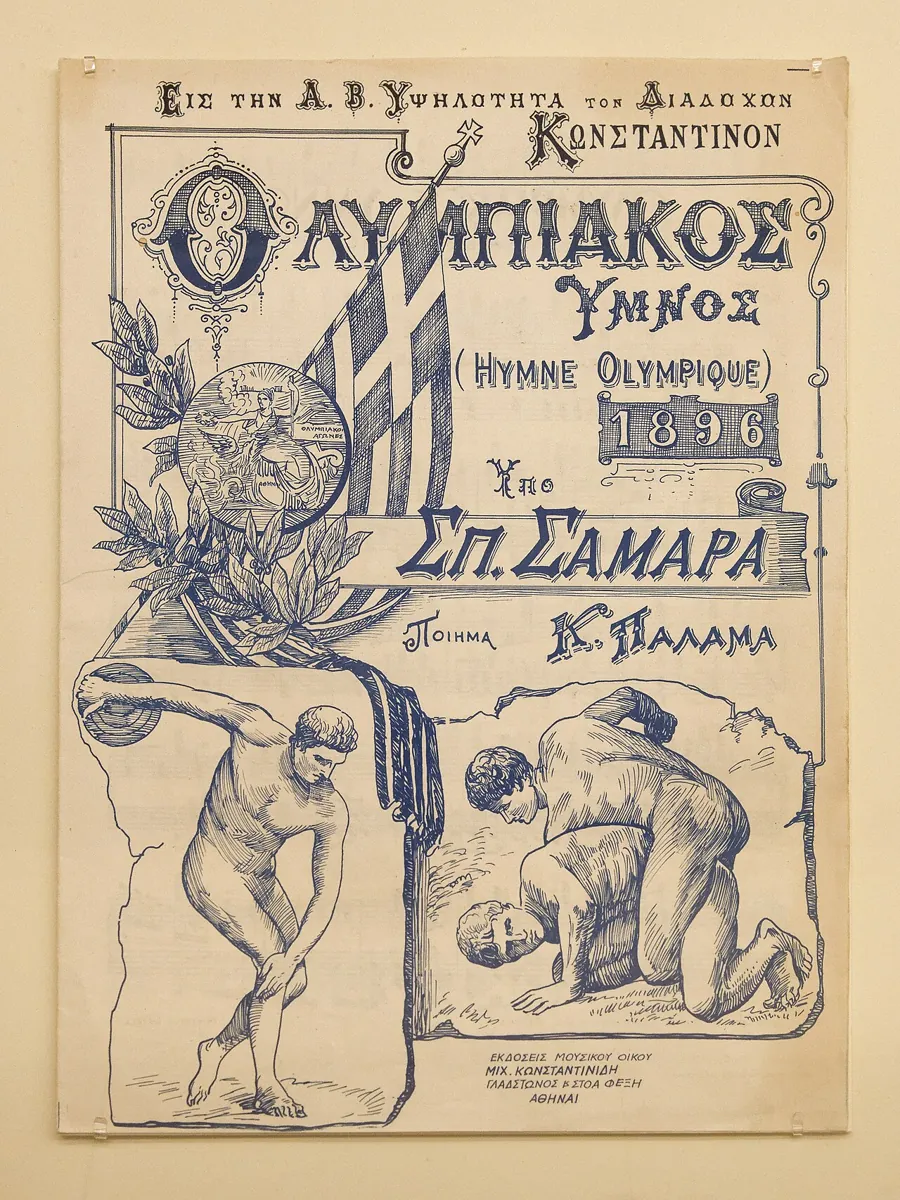
Spyridon Samaras was born in Corfu on 29 November 1861 and died in Athens on 7 April 1917. He studied at the Athens Conservatory and then at the Paris Conservatoire from 1882, where his teachers included Massenet, Delibes, Dubois and Gounod. He wrote fifteen stage works and three operettas, with premieres in Italian cities such as Milan, Rome and Genoa. His best-known piece is the Olympic Hymn, composed at the request of Demetrius Vikelas with words by Kostis Palamas and first performed at the opening ceremony of the 1896 Games. Wikipedia says it was largely forgotten for about fifty years before being performed at the 1958 session of the International Olympic Committee in Tokyo, which declared it the Olympic anthem. It has opened every ceremony since the 1960 Winter Olympics.
Frequently asked questions
What is the Ionian school of music?
A group of composers from the Ionian Islands, active from the early nineteenth century to about the 1950s, who moved from Italian models towards Greek language and folklore.
Which composers were born in Corfu?
Mantzaros (1795), Xyndas (1812) and Samaras (1861) were all born in Corfu, according to Wikipedia.
Will the jazz night play any of this?
Not necessarily. The booking page names standards, modern interpretations and improvisation, and a host who tells stories about the island’s musical heritage.
Sources